
Is Montevideo Worth Visiting? An Honest 2026 Answer
This post has affiliate links. We earn a small commission, which helps us create better content and share amazing destinations with you at no extra cost.
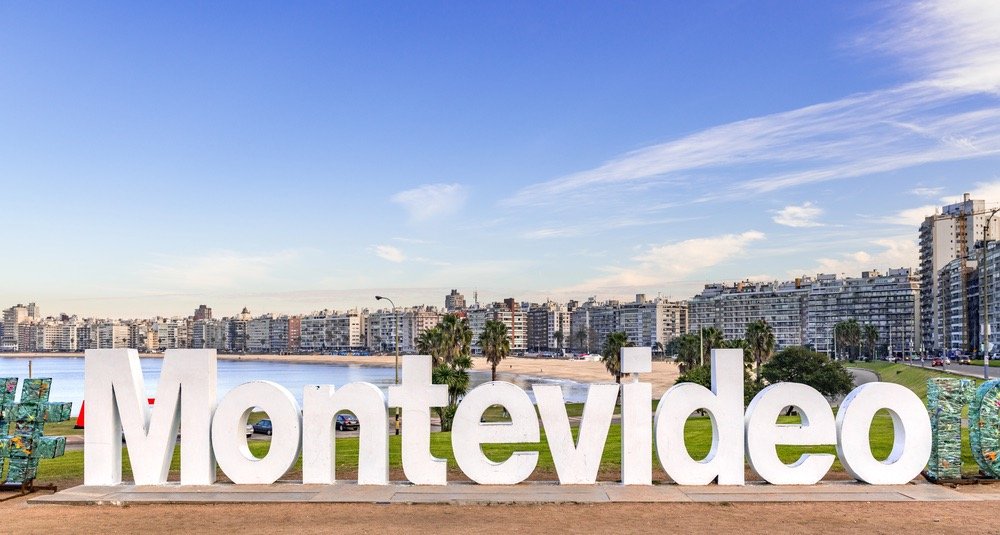
On this page
Travel essentials we use
On this page
Is Montevideo worth visiting, or is it just a quick stopover on the way to the famous beaches of Punta del Este?
We didn’t exactly choose to spend five days in Montevideo.
After four weeks at sea from Germany, our Defender spent another five days waiting for port clearance (here’s how we shipped our car from Germany to Uruguay).
By day three, we knew exactly which parts of Montevideo deserve your time and which ones don’t.
This guide is for couples and travelers deciding whether Montevideo earns a place in their Uruguay itinerary, and if so, for how many days.
VERDICT:
Yes, if you have two or three days, especially if you’re arriving by ferry from Buenos Aires. If your whole Uruguay trip is under five days, give Montevideo one night on your way east, or skip it if you’re flying in and heading straight to the coast. Skip it too if beaches and nightlife are the entire point of your trip.
📅 Three days is the sweet spot: enough for Ciudad Vieja, Pocitos and a long tango dinner without running out of things to do.
💵 Budget more than you’d expect for South America: We spent around $60 (€55) per person per day eating out, and one chivito plate with two drinks at Mercado del Puerto cost us $34 (€31).
👉 Go to Mercado del Puerto on a weekday lunch: on Sundays it’s mostly tour groups.
Who will love Montevideo, and who should skip it
WHO THIS IS FOR:
- Coming from Buenos Aires? Yes: the ferry crossing is short (2.5 hours), and Montevideo is the first taste of Uruguay. Even on a short Uruguay trip, one night here makes sense.
- Choosing between Montevideo and Punta del Este for a two-day stop? Pick Montevideo if you want a lived-in capital; pick Punta del Este if beaches are non-negotiable. You won’t get both in two days.
- Spending two weeks or more in Uruguay? Yes, easily: the extra days let you slow down instead of rushing between landmarks.
- Overlanding or road-tripping? Yes, it’s an easy base for a few nights, with surveilled parkings available in the city.
- Visiting Uruguay primarily for beaches? Skip it, or cap it at one night. Your time is better spent in Punta del Este, José Ignacio, or Cabo Polonio.
- Chasing nightlife? Skip it. Montevideo shuts down early outside summer weekends.
Bottom line: Montevideo earns a place on your itinerary if you value feeling settled somewhere over checking off sights. It doesn’t earn a place if beaches or nightlife are why you came to Uruguay.
Not sure how Montevideo fits into a wider Uruguay trip? Our Uruguay itinerary guide lays out 7, 10, and 14-day routes.
What’s actually worth doing in Montevideo
Not every Montevideo “highlight” on other blogs is worth your time.
Here’s what we’d actually spend a day on, and what we’d skip if you’re tight on time.
You can follow our one-day itinerary for Montevideo
Mercado del Puerto: worth it, but only on a weekday
Go for a weekday lunch, not a Sunday.
Watching the meat on the huge wood-fired grills, having a glass of wine at the counter, and sitting next to both tourists and dockworkers is a classic Montevideo moment.
On a Sunday, though, it’s mostly tour groups.
Keep in mind it isn’t cheap: one chivito plate with two drinks cost us $34 (€31).

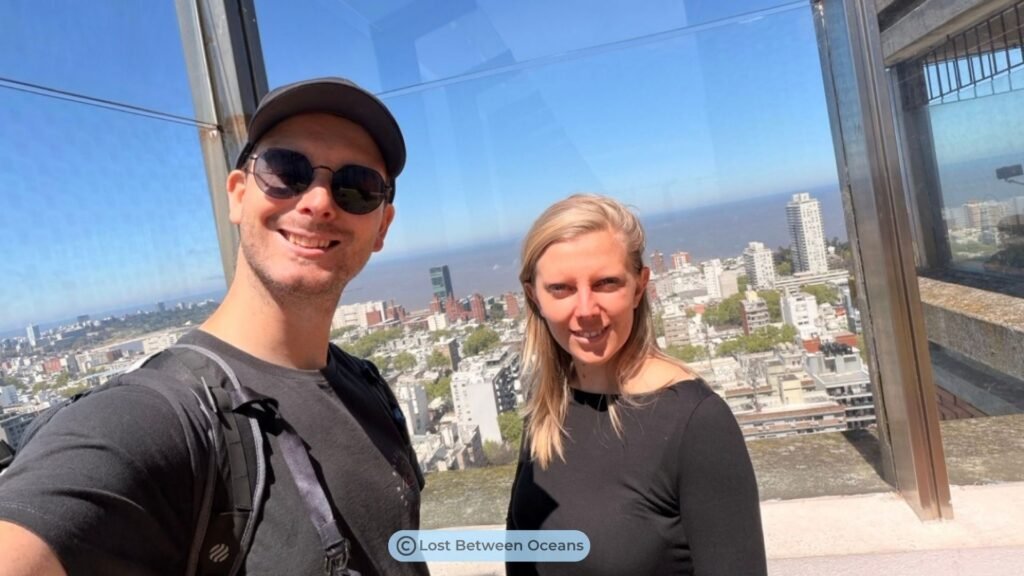
Mirador de la Intendencia: our favourite free thing to do
The best thing we did in Montevideo didn’t cost anything.
Take the elevator up the Intendencia, Montevideo’s city hall, to the viewpoint at the top, and you get the whole city below you, for free.
You just have to reserve your QR code in advance. It’s open every day from 11 am until 7 pm.
There is even a small café at the top with some biscuits!
Ciudad Vieja: worth a slow half-day, not a rushed hour
Start at Plaza Independencia, where the mausoleum of national hero José Gervasio Artigas sits underground beneath his equestrian statue.
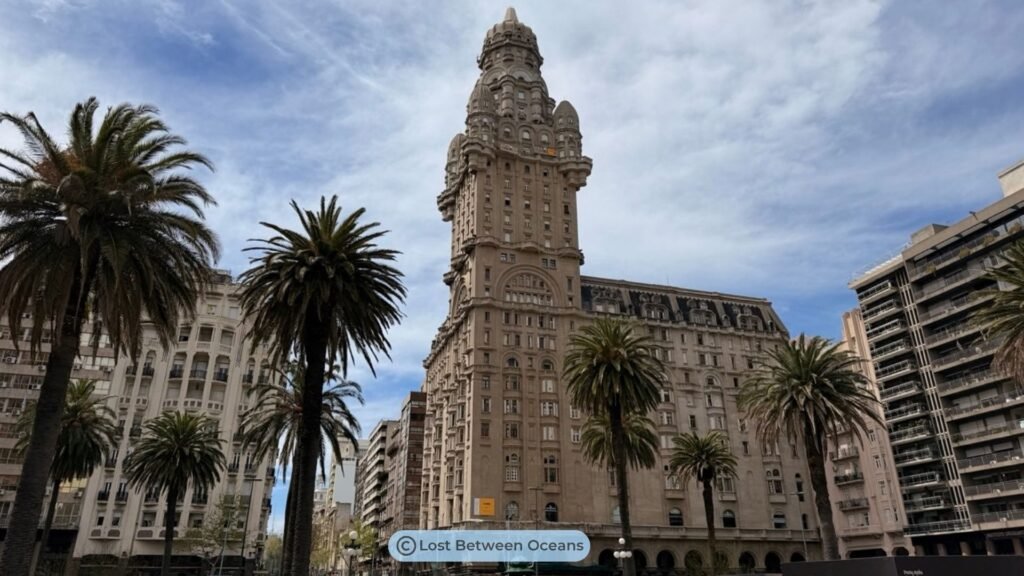
On the corner, the Palacio Salvo dominates the skyline with its Art Deco silhouette, and there’s a half-hidden Masonic emblem above the entrance that most people walk straight past.
To cross into the old town, walk through the Puerta de la Ciudadela, the stone gate that marks the line between old and new Montevideo.
Keep going straight, and you’re on Peatonal Sarandí, the pedestrian shopping street that leads you into the heart of Ciudad Vieja.

Look down as you walk: Sarandí has a run of sun-shaped pavement tiles called the Espacio de los Soles, Montevideo’s own walk of fame honoring Uruguayan writers, artists, and footballers.
The real value here isn’t any single building.
It’s wandering without a fixed stop list, ducking into side streets and letting the neighborhood unfold.
If you’d rather have a loose route to follow, our one-day Montevideo walking guide maps out the stops we liked most.
Insider tip: Go on a weekday morning. On Sundays, many shops along Sarandí stay closed, and the old town feels noticeably quieter.
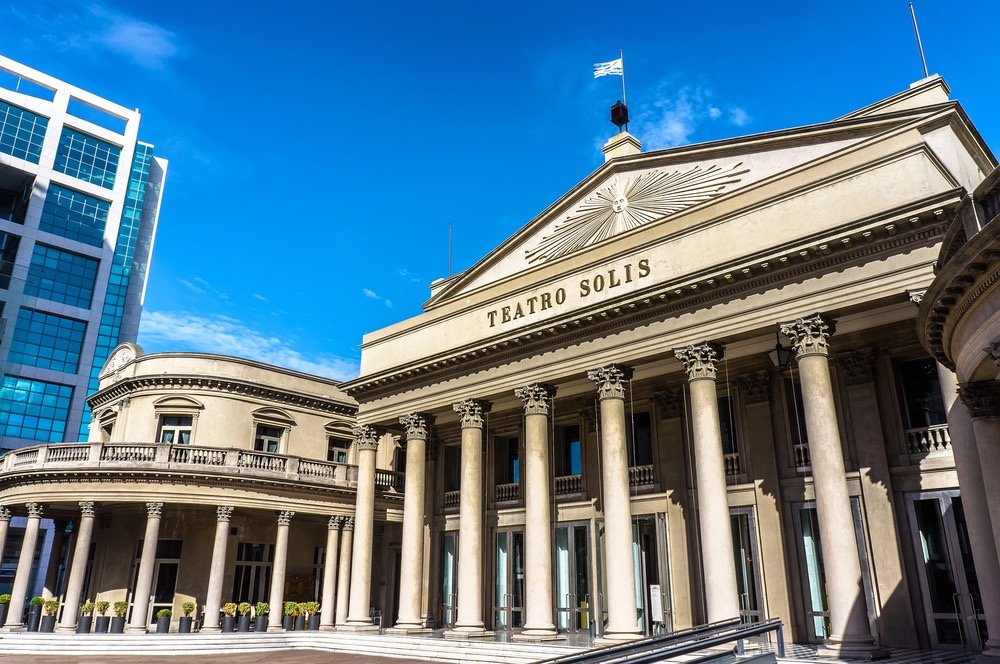
Teatro Solís: only worth it if you see a show
Tickets run a fraction of what opera or ballet costs in Europe, so if there’s a show on while you’re in town, take it, though it will be in Spanish, of course.
We only walked past the building for the architecture, and on its own that wasn’t really worth it.
Estadio Centenario: for football fans only
This is where the first World Cup final was played in 1930.
We didn’t go: it’s too far from the center to walk, so you’d need a taxi.
If football history isn’t your thing, skip it rather than adding it out of obligation.
Parque Rodó and the Rambla: fold them into a walk
Parque Rodó and the Rambla near Pocitos are worth folding into a walk you’re already taking, not a dedicated trip on their own.
Both are free, which helps balance out Montevideo’s restaurant prices.
See our best things to do in Montevideo guide for the deeper version of this list, with bookable options and prices for the ones worth paying for.
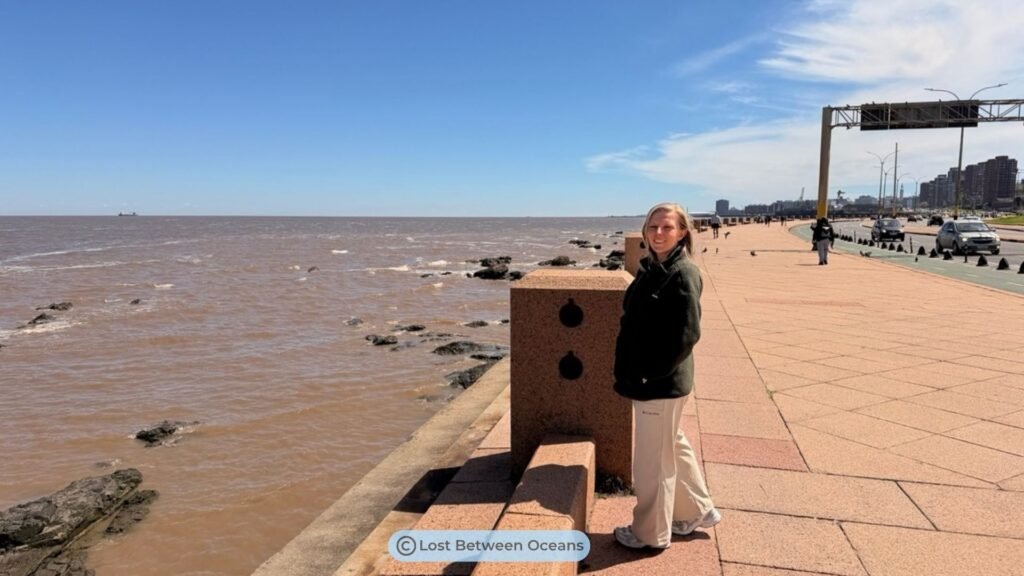
If your evening plans include a long asado and a slow walk along the water rather than nightlife, that’s when Montevideo delivers.
Go to Pantagruel for amazing meat, or book Primuseum for a five-course dinner with a tango show.
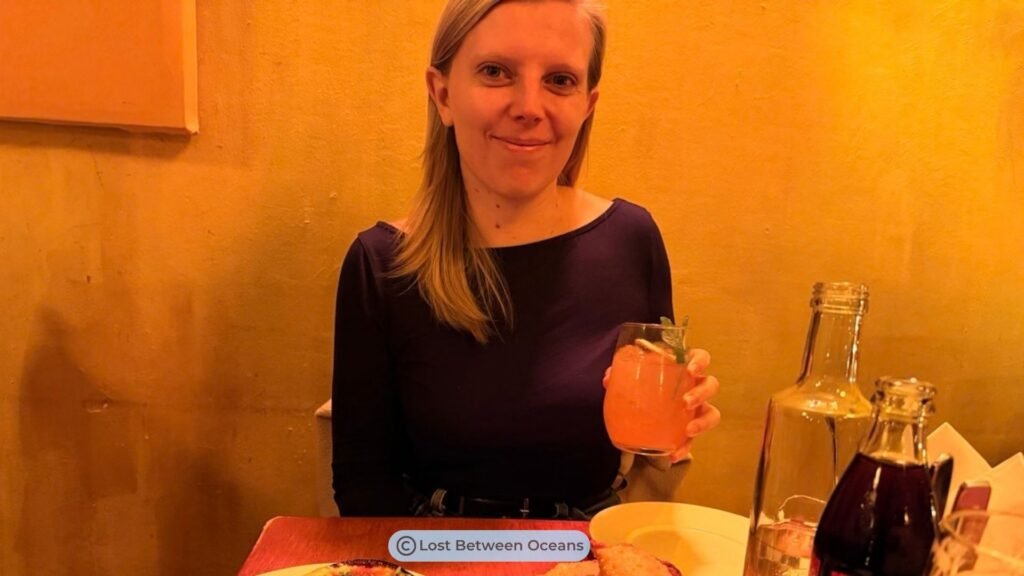
Primuseum is the evening we’d book as a couple: between the tango dancing, Santiago, the owner, told us about his love for Primus stoves, the little burners Uruguayans used to cook on for generations.
Want to know where we’d actually eat?
See our Montevideo restaurant picks by neighborhood and budget, beyond the Mercado del Puerto tourist counters.
See our Montevideo restaurant picksIs Montevideo safe?
In the 2026 Global Peace Index, published by the Institute for Economics and Peace, Uruguay ranked 43rd out of 163 countries and was the most peaceful country in South America, ahead of Chile and Argentina.
That’s a country-level ranking, not a Montevideo one, but it matched our experience: in five days in the city, we never felt unsafe.

You’ll smell cannabis on some squares.
It’s legal and regulated by the state in Uruguay, so nobody bothers hiding it.
The one thing we’d recommend: take an Uber or taxi back after dinner.
Plenty of people walk around Pocitos and Ciudad Vieja at night, but some streets looked quite dark to us, and a 40-minute walk back to our hotel at 11 pm felt too far.
What this means for your decision: if personal safety is a deciding factor in whether Montevideo makes your itinerary, our experience says it shouldn’t be a reason to skip it.
How much does Montevideo cost?
Uruguay is often called one of the most expensive countries in South America, and groceries show you why straight away.
We easily paid $25 (€23) for just a few items at the supermarket, and you’ll immediately notice which fruits and veggies are imported and which are grown in Uruguay or neighbouring countries.
We spent around $60 (€55) per person a day, eating out for most meals. Based on that:
Summary:
- 💵 Budget traveler: $35 – 45 (€32 – 41) a day: hostel beds, cooking your own meals, buses
- 💵 Mid-range traveler: $60 – 90 (€55 – 83) a day: a private room or apartment in Pocitos or Punta Carretas, eating out most meals (this is where we landed)
- 🍖 Parrilla dinner for two with wine: $30 – 45 (€28 – 41)
- 🥘 Set lunch menu, neighborhood spot: $8 – 12 (€7 – 11)
What this means for your decision: Montevideo definitely isn’t a budget destination, so plan for European-style prices rather than typical South American ones. At the mid-range end, it’s a bit still less than Punta del Este in high season.
How many days do you need?

One full day covers Ciudad Vieja and the Mercado del Puerto if you’re tight on time; see our one-day in Montevideo guide.
Two days let you add Pocitos, Punta Carretas, and a proper sit-down dinner.
We’d suggest three if this is your first stop in Uruguay; our 3 days in Montevideo itinerary lays that out hour by hour.
Staying 2 to 3 nights? Here’s where we’d sleep.
We’d choose Ciudad Vieja if you want to walk everywhere and don’t mind weekday noise. We’d choose Pocitos if you want a quieter, more residential base near the Rambla. We wouldn’t book Punta Carretas unless you’re staying a week or more and want a local, non-touristy feel over convenience.
See where we’d stay in MontevideoGetting around Montevideo
Montevideo doesn’t have a metro or tram system, and it doesn’t need one for the areas most visitors care about.
Ciudad Vieja, the Centro, Pocitos, and Punta Carretas sit along roughly 8 km (5 miles) of coastline, walkable in sections and connected by city buses.
While our Defender was stuck at the port, we walked a lot during the day and took an Uber to restaurants in the evening.

Summary:
- 🚌 Bus fare: $1.20 (€1.10), paid via the STM card
- 🚕 Cross-town taxi/Uber: $6 – 8 (€5.50 – 7.30) RECOMMENDED
- 🚗 Parking: tight and metered in Ciudad Vieja on weekdays; a guarded lot near the port beats hunting for street parking. Once our Defender was released, we left the city and drove east to Parque del Plata on the coast.
Montevideo vs Buenos Aires vs Punta del Este
The right comparison depends on what you’re actually choosing between:
If you’re deciding whether to add Montevideo to a Buenos Aires trip: yes, the ferry crossing is short (see our Buenos Aires to Montevideo ferry guide, and Buenos Aires is bigger, louder, and has more to see on a checklist, while Montevideo is calmer and easier to feel settled in within a couple of days.
They’re different enough to both be worth it if you have the time.
If you’re choosing between Montevideo and Punta del Este for a short window: Punta del Este is a beach and nightlife town with little of Montevideo’s everyday texture.
Pick based on which of those two things you actually want from a short trip, not on which city is “better.”
If you only have time for one Uruguayan stop coming from Buenos Aires: give Montevideo one night, then head east. It’s the closer crossing and the easiest introduction to the country.
Best time to visit Montevideo
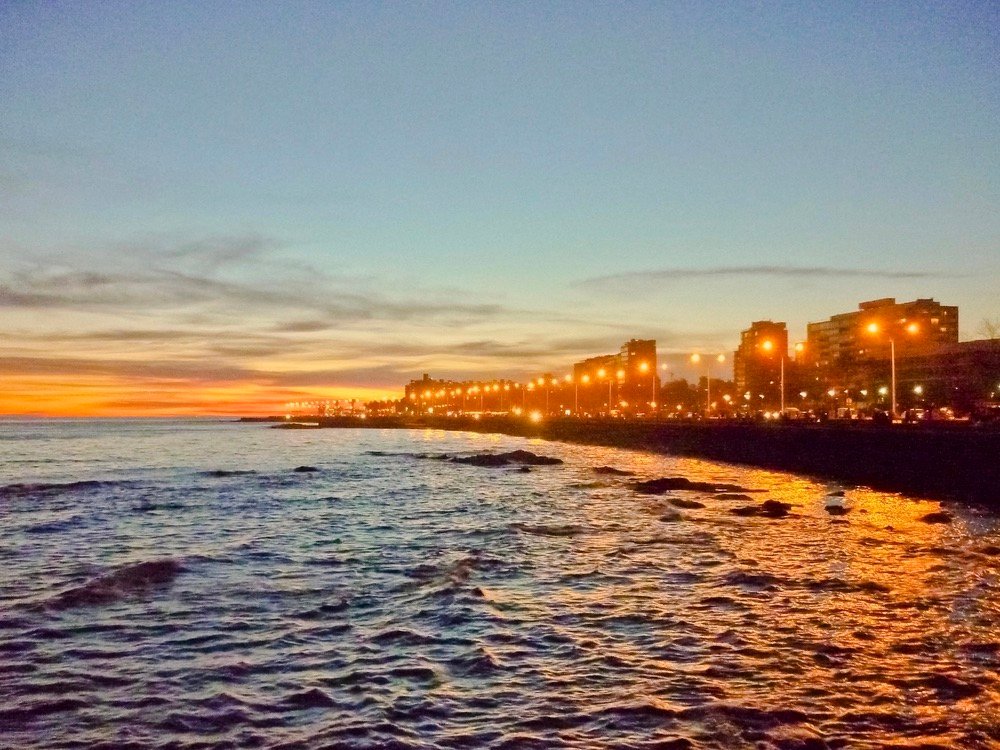
Uruguayan summer (December through February) brings the warmest weather and the liveliest Rambla, but also the highest accommodation prices as Argentinians cross the river for their own holidays.
We visited in October.
It was around 14°C (57°F) on cloudy days and closer to 20°C (68°F) when the sun came out, so pack a warm layer. In return, we got thinner crowds and better hotel rates.
Final thoughts on visiting Montevideo
So, is Montevideo worth visiting?
Yes, as long as you come for what it actually is: a calm, lived-in capital where the best moments are a slow walk through Ciudad Vieja, a weekday lunch at the Mercado del Puerto, and a long asado followed by a stroll along the Rambla.
It won’t give you beaches or nightlife.
We ended up spending five days in the city while our 4×4 was stuck at the port, and honestly, three days would have been perfect.
That’s enough to see Ciudad Vieja without rushing, add Pocitos and Punta Carretas, and still have an evening for a proper parrilla or the tango dinner at Primuseum.
Any longer and you start running out of things to fill the days, unless, like us, you have a car to wait for.
Ready to plan it? Our 3 days in Montevideo itinerary lays out exactly how we’d spend those days, hour by hour.
Planning the rest of your trip?
See our full Uruguay itinerary guide, with 7, 10, and 14-day routes from Montevideo to Punta del Diablo.
Plan your Uruguay itineraryWritten by Laura and Alexander, a travel couple overlanding through Uruguay, from Montevideo’s Ciudad Vieja to the wineries of Carmelo.

*Disclosure: Please note that some of the links on our site are affiliate links, and at no additional cost to you, we may earn a commission of you decide to make a purchase after clicking through the link.
We only recommend products and services that we use and love ourselves, so we know you’ll be in good hands. The commission we receive helps us to maintain our website and continue to provide high quality content for our readers.
Please check our affiliate disclosure policy for more details.
Your suppport is appreciated!
We share travel guides for couples who want a little luxury, a lot of heart and lifelong stories to tell!
Laura and Alexander
Founders of Lost Between Oceans

Reviews
Lost Between Oceans gave me and my husband the perfect tips and destinations to plan our dream honeymoon in French Polynesia, making the experience stress-free.

I never thought I’d dare to go diving in a cenote and surfing in Mexico. Their travel guides made me more confident and adventurous, overcoming my travel fear of the unknown. Thank you!
I looked up Lost Between Oceans for last-minute tips about my roadtrip in the Amalfi Coast. They showed me the best cliffside villages and hidden beaches. This saved me a lot of time researching everything myself!