
Money in Uruguay: Currency, Cards, ATMs, and Tipping
This post has affiliate links. We earn a small commission, which helps us create better content and share amazing destinations with you at no extra cost.
On this page
Travel essentials we use
On this page
Money in Uruguay works differently from its neighbors.
Our first lesson came at the ATM: the Abitab machine we tried wouldn’t accept our foreign card at all, and every other bank ATM that did charged us 100 pesos per withdrawal.
This money in Uruguay guide covers the four decisions you actually need to make before you go: currency, cards, ATMs, and tipping, which we noticed during our three weeks in the country.
It also covers the one thing most travelers miss: paying with a foreign card can take the VAT off your restaurant bill.
VERDICT:
For a typical trip, one no-fee multi-currency card and some pesos in cash for small vendors covers nearly everything. Pay by card wherever you can at restaurants: foreign cards can get a VAT discount; cash never does (so paying by card is cheaper). You don’t need to bring US dollars.
💳 Pay by foreign card at restaurants: tourists paying with a card issued abroad can get a VAT discount on food and drinks, so cash costs you more.
💵 Uruguay is very expensive for South America: We spent around $60 (€55) per person per day in Montevideo, eating out most meals.
🏧 Use RedBROU ATMs, not Abitab: We paid 100 pesos (about $2.50 / €2.20) per withdrawal with our Wise card, and Abitab machines didn’t accept our foreign card.
👉 Always pick “local currency”: when an ATM or card machine asks; letting it convert for you is always the worst rate.
Currency: the Uruguayan peso
The official currency is the Uruguayan peso (UYU), written as $ or $U.
Prices in shops just show “$”, so if you see a dollar sign in a Montevideo shop window, it always means pesos.
As of October 2026 (when we were there), the Uruguayan peso to USD rate sits around 40 pesos to the dollar.
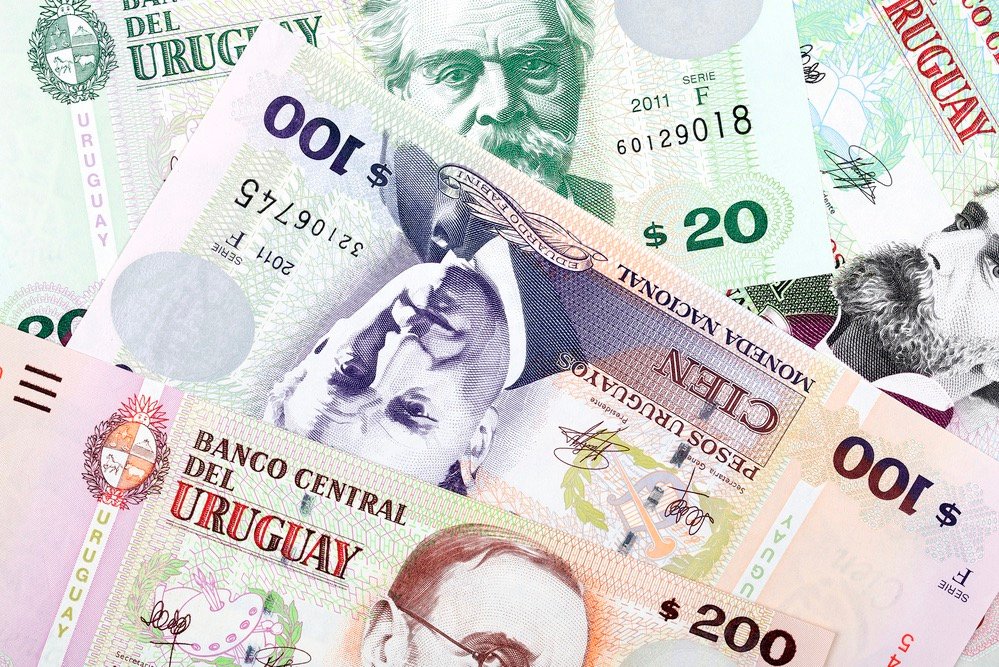
Notes come in $20, $50, $100, $200, $500, $1,000, and $2,000 pesos, and coins in $1, $2, $5, and $10 pesos.
Should you bring US dollars?
We didn’t need them.
Almost everywhere we went, they wanted a card or pesos in cash, so bringing a stack of dollars would just mean exchanging them again.
By the end, we ran out of cash; they did not accept cards, so we wanted to pay with USD in cash, but they would not accept it. Only cash Uruguayan pesos.
A card plus a few ATM withdrawals in pesos covered everything for us.
Is Uruguay expensive?
Yes, by South American standards.
It’s one of the most expensive countries on the continent.
In Montevideo, we paid $25 (€23) for just a few supermarket items, and spent around $60 (€55) per person a day eating out most meals.
See our Montevideo is worth visiting post for the full breakdown.
Summary:
- 💵 Budget traveler: $35 to $45 (€32 to €41) a day: hostel beds, cooking your own meals, buses
- 💵 Mid-range traveler: $60 to $90 (€55 to €83) a day: private room, eating out most meals (where we landed)
- 📈 Peso stability: one of the more stable currencies in the region, but not fixed
Cards: what we’ve used and why
Visa and Mastercard are the two cards you’ll actually use, accepted at most hotels, mid-range restaurants, and supermarkets in Montevideo and the coastal towns.
American Express has weaker acceptance, so don’t build a trip around it.
Smaller family-run restaurants, market stalls, and rural guesthouses always prefer cash, even if they technically take cards. This means you’ll also pay the ‘normal’ price and not get the VAT discount.
The VAT discount for foreign cards
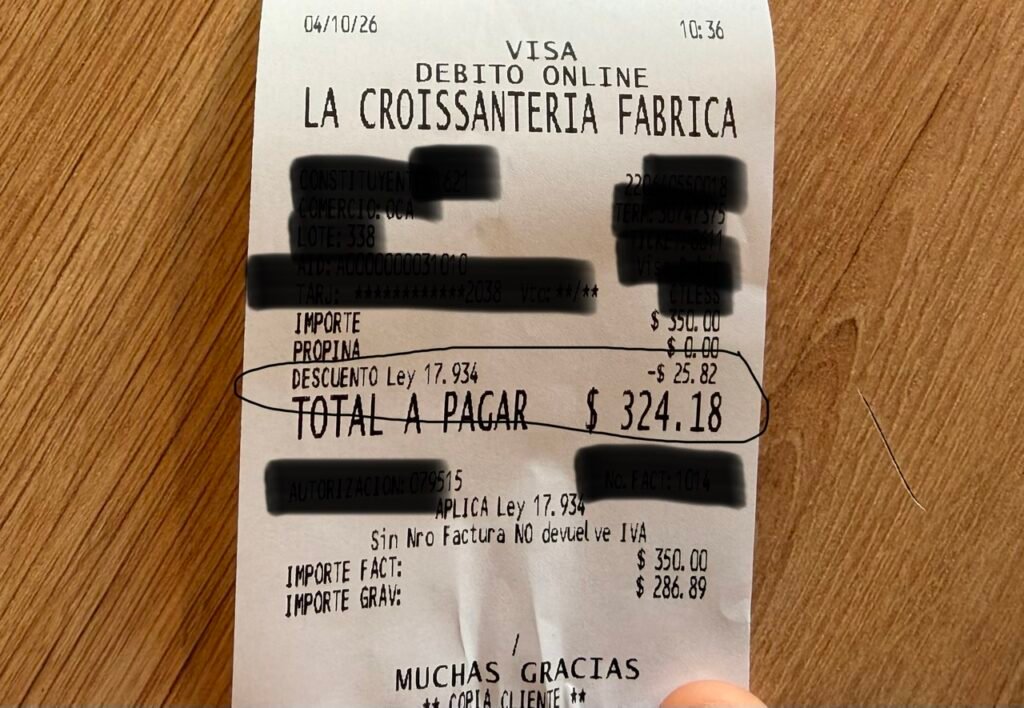
This is the biggest money tip we can give you for Uruguay.
Non-resident tourists who pay with a card issued outside Uruguay can get a reduction on IVA (Uruguay’s 22% VAT) at restaurants, bars and cafés, and on car rental.
Hotels can also invoice non-residents without IVA.
The discount shows up on the receipt or later on your card statement.
Cash gets NO discount.
In our experience, paying with our foreign Visa always got us a discount, sometimes up to 15% off the bill.
Part of that is the VAT reduction for tourists, and some restaurants add their own promotions for foreign cards.
Don’t count on the restaurant card promotions you’ll see advertised for platinum and other premium cards, though: those are for Uruguayan bank cards, not foreign ones.
Why we use Wise
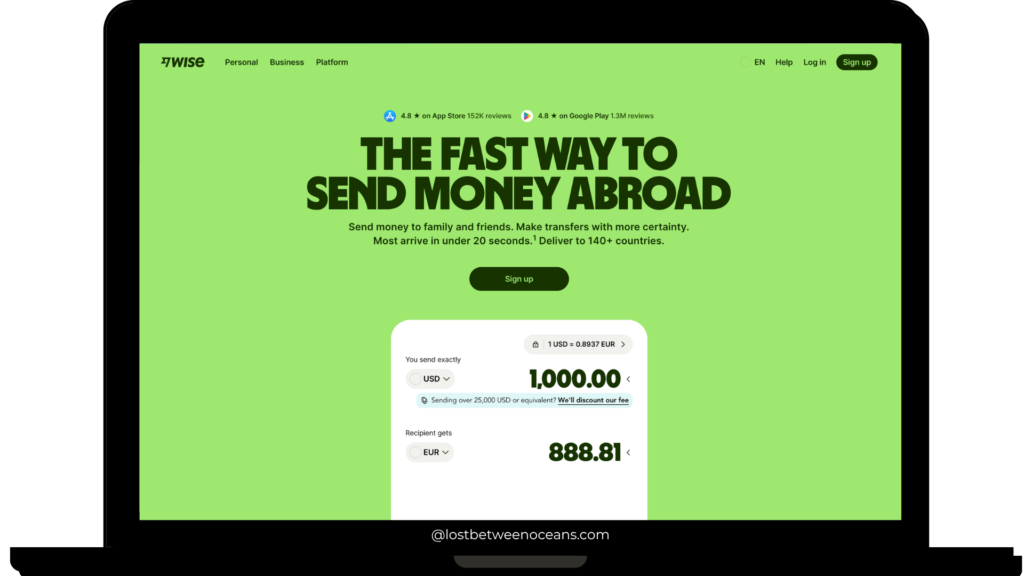
For us, Wise has been the simplest card for everyday spending.
Wise uses the mid-market exchange rate plus a small, upfront conversion fee instead of a hidden markup.
As a couple, we share a joint Wise account, so we both pay from the same balance and never have to settle up who paid for dinner.
Where it hasn’t been the obvious answer: it’s a card you need to set up and load before you fly, not something you can sort out at the airport, and it doesn’t remove ATM withdrawal fees on the Uruguayan side, only the markup on the currency conversion itself.
WHO THE WISE CARD IS FOR:
- Anyone making more than a handful of card purchases on the trip. The avoided conversion markup adds up across a week or more.
- Longer-stay travelers and overlanders. A multi-currency balance means you’re not reloading a prepaid card every time you cross a border.
- Anyone who’s been hit by “dynamic currency conversion” before. You settle in pesos at a disclosed rate instead of guessing what your home bank will charge back.
Skip setting one up if you’re only in the country for a couple of days, or if your regular debit card already has no foreign transaction fees. The setup time isn’t worth it for a short trip.
Staying more than a few days?
This is the card we use for everyday spending in Uruguay. Set it up and load it before you fly; it isn’t something you can sort out at the airport.
Get the Wise card we useATMs: where they work and where they don’t
With our Wise card, every withdrawal cost us 100 pesos (about $2.50 / €2.20), and the fee was the same at every bank we tried.
The ATMs we’d point you to are RedBROU, the network of BROU (Banco República, the state bank), which worked best for us.
You’ll also see Santander and Itaú ATMs in Montevideo, Punta del Este, and Colonia.
👉 INSIDER TIP: skip the Abitab machines. They’re everywhere, but they only work with Uruguayan cards, not our foreign one (we tried).
Summary:
- 💵 ATM fees: 100 pesos (about $2.50 / €2.20) per withdrawal in our experience, plus whatever your own card provider charges
- 📍 Reliable coverage: Montevideo, Punta del Este, Colonia
- ⚠️ Scarce elsewhere: smaller coastal and inland towns
KEEP IN MIND: outside the big three, ATMs get scarce fast. Withdraw more than you think you need before you leave the bigger cities.
| Uruguay money at a glance | ||
| 💱Currency: Uruguayan peso ($ or $U) | 📊Exchange rate: ~40 UYU per $1 USD (check current) | 🏧ATM fee: ~100 UYU (about $2.50 / €2.20) |
| 🍽️Restaurant tip: 10% | 💳Restaurants: pay by foreign card for the VAT discount | 💵Daily budget: $35–90 (€32–83) |
See what a day in Uruguay actually costs
A full region-by-region breakdown, from Montevideo to Punta del Este in high season.
Read the Uruguay cost breakdownTipping in Uruguay
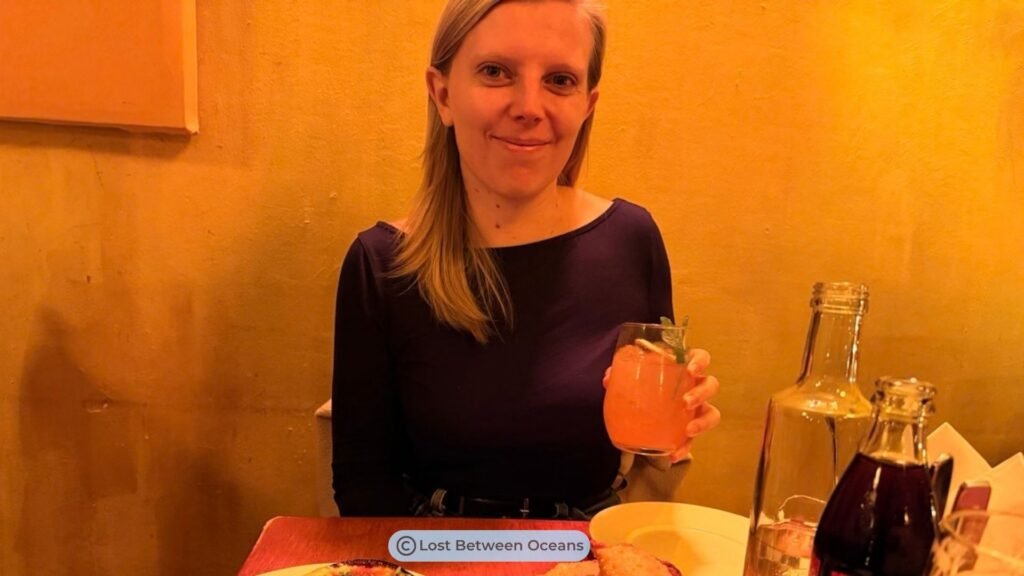
Tipping in Uruguay is more modest than in the US.
Most guides say around 10% at restaurants is standard, but in practice nobody asked us for a tip anywhere except the Mercado del Puerto, where they asked at the end of the meal whether we wanted to add one.
Summary:
- 🍽️ Restaurants: around 10% if you’re happy with the service. It isn’t added automatically, and you likely won’t be asked at tourist spots.
- 🚕 Taxis: round up to the nearest convenient note
- 🧳 Hotel bellhops/porters: $1.20 to $2.30 (€1.10 to €2.10) per bag
- 🥾 Tour guides: $9 to $18 (€8 to €17) per person for a half-day tour, more for a private full-day like a Carmelo wine tour
👉 INSIDER TIP: if you want to tip after paying by card, keep a few small peso notes on you, since most places won’t prompt you to add one.
A quick checklist for your money in Uruguay
- Not sure yet where the money will actually go? See our best things to do in Uruguay and what to pack for Uruguay guides for the fuller planning picture.
- If a no-fee travel card fits your trip, set it up (and load it) before you fly. It’s not a same-day fix.
- Pay restaurants with a foreign card, not cash, to get the VAT discount.
- Carry at least two payment methods in case one is declined.
- Withdraw extra cash before leaving Montevideo, Punta del Este, or Colonia if you’re heading somewhere smaller.
- Keep a mix of small and large peso notes, since vendors outside the capital often can’t break large bills.
Our take
Money in Uruguay isn’t complicated once you split it into its four parts:
- pesos for small vendors,
- a foreign card for restaurants (where it can save you the VAT),
- ATMs in the big three cities before you head anywhere smaller,
- and a 10% tip.
For us, that card has been Wise, but if your trip is short or your debit card already has no foreign fees, you don’t need it.
Make those four decisions before you land, and Uruguay’s prices will sting a lot less.
Planning the rest of your trip?
See our full guide to getting around Uruguay, from city buses to the coastal route.
Read the getting-around guideWritten by Laura and Alexander, a travel couple overlanding through Uruguay, from Montevideo’s Ciudad Vieja to the wineries of Carmelo.
Related Posts

*Disclosure: Please note that some of the links on our site are affiliate links, and at no additional cost to you, we may earn a commission of you decide to make a purchase after clicking through the link.
We only recommend products and services that we use and love ourselves, so we know you’ll be in good hands. The commission we receive helps us to maintain our website and continue to provide high quality content for our readers.
Please check our affiliate disclosure policy for more details.
Your suppport is appreciated!
We share travel guides for couples who want a little luxury, a lot of heart and lifelong stories to tell!
Laura and Alexander
Founders of Lost Between Oceans

Reviews
Lost Between Oceans gave me and my husband the perfect tips and destinations to plan our dream honeymoon in French Polynesia, making the experience stress-free.

I never thought I’d dare to go diving in a cenote and surfing in Mexico. Their travel guides made me more confident and adventurous, overcoming my travel fear of the unknown. Thank you!
I looked up Lost Between Oceans for last-minute tips about my roadtrip in the Amalfi Coast. They showed me the best cliffside villages and hidden beaches. This saved me a lot of time researching everything myself!



Related Posts