
11 Best Things to Do in Colonia, Uruguay in 2026 (With Itinerary)
This post has affiliate links. We earn a small commission, which helps us create better content and share amazing destinations with you at no extra cost.

On this page
Travel essentials we use
On this page
We spent three nights in Colonia, wild camping in our 4×4 in a parking area next to the beach, plus one night in a cottage at La Vigna, before moving on to Buenos Aires.
Here are the best things to do in Colonia, Uruguay, whether you have one day or three nights, with our honest verdict on what is worth your time and money.
🍷 Do the day trip with Silex Tours. Our day with Andres covered the old town, the lighthouse, the bullring and a three-course lunch at Fripp winery, with nobody driving.
🧀 Don’t skip La Vigna cheese farm. It was an amazing experience and by far the best cheese tasting we have ever done. The Tannat cheese was our clear winner.
⛴️ Plan around the ferries. Colonia is often visited as a day trip from Buenos Aires, so the old town fills up mid-morning and empties again in the late afternoon. Go early or stay the night to see it at its best.
Coming over on the morning ferry from Buenos Aires? Follow the One Day table below. Have a car or can stay a night? Take the longer plan.
⭐ What is worth it in Colonia
Worth it: the old town on foot (the Barrio Histórico), Calle de los Suspiros, a winery visit and a cheese tasting. Everything else is optional, and we tell you what to skip further down.
Watch our Colonia video below to get a feel for the town!
How many days do you need in Colonia?
If you visit Colonia, Uruguay, for one full day, you’ll cover the old town, but one night is better, because the town empties after the last ferries, and that is when it’s at its best.
TWO NIGHTS is the sweet spot if you also want a wine tour and the ride to Real de San Carlos.
INSIDER TIPS
🌅 Go early or late: the old town is quiet before 10:00 and after 18:00.
🏛️ Pick a few museums: they’re small, so two or three on the shared ticket is plenty.
🚲 Leave the walls once: the Rambla and Real de San Carlos show a different Colonia.
🧀 Taste local cheese: La Vigna’s organic cheese farm is the best food stop outside the old town.

Colonia Uruguay things to do: Summary
| ⭐ Top sight: the Barrio Historico on foot | 📸 Best photo: Calle de los Suspiros, early |
| 🏛️ Best view: the Colonia lighthouse, late afternoon | 🍷 Best half day out: a winery tour with Silex Tours |
| 💸 Best free thing: sunset from the western tip | ⏱️ Time needed: 1 full day, or 2 nights to slow down |
| 🧀 Best food stop: La Vigna cheese farm | 📖 Best stories: a day with Andres at Silex Tours |
Coming on the morning ferry? Here is how we’d use one day:
| 🗓️ One Day in Colonia: Our Short Itinerary | |
|---|---|
| 9:30 | 🚪 Enter through the Portón de Campo and discover the Barrio Historico before the ferry crowds arrive. |
| 10:00 | 📸 Photograph Calle de los Suspiros while it’s still empty. |
| 11:00 | 🏛️ Two or three small museums on the shared ticket, plus the Basilica and Plaza Mayor. |
| 13:00 | 🍽️ Long lunch a few blocks outside the walls, where it’s cheaper than the Plaza Mayor. |
| 15:00 | 🚲 Cycle the Rambla to the Real de San Carlos bullring, or spend the hour at a river beach. |
| 17:00 | 🗼 Climb the Colonia lighthouse, then sunset from the western tip with some maté. |
Want the winery included? Skip to our day with Silex Tours below.
Before you start: Why timing is everything in Colonia
Colonia’s rhythm is really set by the boats from Buenos Aires.
Our guide joked that he could tell how busy the town would be just by the COLOUR OF THE WATER. When the ferries arrive, they stir up the river and turn it brown, so he knows the boats are in. Since they run on a fixed schedule, it also tells him roughly what time it is.
Day-trippers arrive mid-morning, fill the old town by lunch, and head back in the late afternoon.

Many tourists we met in Colonia mentioned this as well; they just come over for the day for some shopping, have good meals, and head back in the afternoon.
So our to-do list below is grouped into morning, middle of the day, and evening.
If you only have ONE DAY, you’ll still be able to use it; you’ll just be doing the morning section with company.
Morning
Walk the Barrio Histórico

The Barrio Histórico is why Colonia appears on every Uruguay itinerary (including ours)!
Founded by the Portuguese in 1680 and listed by UNESCO in 1995, it’s a small area of cobbled lanes, low tiled houses, old street lamps, and classic cars parked like props.
⚡ You won’t see a single overhead wire in the old town. The city buried them all underground to keep the nostalgic look of the old streets.
Our guide Andrés from Silex Tours turned our walk into a story.
Colonia is older than Montevideo, and for a long time it was a strategic border town that the Portuguese kept attacking and that changed hands by treaty, part Argentine, part Brazilian.
On a clear day you can see Buenos Aires across the water, and the river is the reason it all mattered: the Río de la Plata means “river of silver,” and silver left South America for Europe along it.
It was also, as Andrés put it, very much a SMUGGLING TOWN, and you can feel it: think Pirates of the Caribbean vibes.
Photograph Calle de los Suspiros

The Calle de los Suspiros, the “Street of Sighs,” is Colonia’s most photographed street: a narrow, sloping run of rough stones with a gutter down the middle, leading towards the river.
Andres told us the reason for its name, and it’s not what you expect!
This lane once ran past gallows and brothels, and convicted men were said to walk it on their way to be hanged.
👉 INSIDER TIP: walk the street downhill towards the water, then turn round. The view back up the slope is the better Instagram photo, and almost nobody stops to take it.
Enter through the Portón de Campo

The reconstructed Portón de Campo, the old city gate with its wooden drawbridge and stone walls, marks the landward edge of the old town.
Andres started the tour here by explaining the town’s history and that this wooden bridge is the border to the old town.
It’s a natural starting point if you’re walking in from the modern centre or the bus terminal.
Middle of the day
See the Basilica and Plaza Mayor

The Plaza Mayor 25 de Mayo is the old town’s main square, shaded by big trees and edged by restaurants.
We went inside, but no images were allowed. It’s quite beautiful, but there was a mass going on,n so we just had a quick look before exiting again.
If you step off the ferry and walk in around 11:00, you arrive with most of the day-trippers, and by lunch the old town is full. Visit the Basilica first, then take lunch a few blocks outside the walls (more on that below). The town empties again in the late afternoon.
A short walk away, the Basilica del Santísimo Sacramento is one of the oldest churches in Uruguay, rebuilt several times over the centuries. It’s a quick visit, and the cool interior is welcome on a hot day.
If you’re here on a Sunday, there’s a Sunday market of local producers. It’s smaller than the markets in Montevideo, so go for a snack and a chat with the stallholders, not for a big shop.
Have a long lunch outside the walls

Old-town restaurants have the setting, and they charge for it.
For the same chivito, pasta or milanesa, you’ll usually pay less a few blocks east in the modern centre. Our plan: one lunch in the old town for the atmosphere, the rest outside it.
For paying, we use a Wise card for most bills; small cafes sometimes prefer cash, so keep a few pesos. Our Money in Uruguay guide explains cards, ATMs, and tipping.
Where to eat in Colonia
We recommend the following places in Colonia for food:
- Charco Bistro: order the steak.
- Parrillada El Portón: a long-running steakhouse, best paired with a local wine.
- Calma Coco: a hearty salad and a lemonade for a lighter lunch in the old town.
- Helados Papito: the coffee ice cream, with vegan options if you need them.
- Barbot: craft beer in the evening, sometimes with live music.
Take a winery tour

Colonia sits at the edge of one of Uruguay’s wine regions, and a definite must-do is to spend a half-day at a winery.
We booked our wine tour with Andres from Silex Tours, who took care of transport and explained a lot more than the winery guide.
KEEP IN MIND: When you book a tour, nobody has to be the designated driver since Uruguay has a 0% alcohol tolerance limit! Booking our tour with Silex Tours solved that issue!
Andres told us the local wine tradition grew out of Italian immigration: Uruguay had around 100,000 people in the mid-1800s, then around 500,000 immigrants arrived (1860s through the 1920s) of which many from Italy, some of which had had a winery in Italy.
The winery we visited was Fripp Winery, about 30 minutes by car from Colonia.

The owner shows you the vineyards and the process, and Andres translates (since the tour is in Spanish) and fills in the history.

Then you sit down to a three-course menu with wine, and it was one of the best things we ate in Uruguay.
Our menu started with a chicken and meat empanada, and each of us got a different wine with it.
The main was a proper steak served with a Tannat, and for dessert you could choose between a few options, all of them delicious!

The Fripp visit and lunch are included in the Silex tour day, so you book it all in one go (details below).
Visit La Vigna cheese farm

La Vigna is an organic creamery and country house on a 35-hectare estate in Colonia Valdense, on Ruta 51 at km 120.
It makes organic cheese from goat, Jersey cow and sheep milk; its signature is the Pecorino Valdense, and the estate offers more than 20 types.

It’s the best food stop we found outside the old town.
We even feature La Vigna in our Colonia YouTube video below!
The main reason to visit La Vigna is definitely the cheese tasting, by far the best cheese tasting we have ever done! At about 60 km from Colonia, it’s a 50-minute scenic drive.
It’s farm-to-fork in the literal sense: the organic farm raises its own goats, and the cheeses made from their milk include a Tannat cheese and a honey cheese.

We spent a night in a cottage on the estate, a quiet, luxurious break from camping. You wake up to the sounds of birds chirping, the goats grazing…
The Tannat cheese was our clear winner. Putting wine into a cheese felt like a daredevil move, and we loved it.

A big thank you to Luciano for walking us around the property, guiding our cheese tasting and looking after us so well during our stay.
🧀 Taste cheese at La Vigna
Plan a cheese tasting at this organic farm, with Tannat and honey cheeses from their own goats, and ask about a room if you want a quiet night in the countryside. Tastings and rooms are arranged directly with the farm.
See La Vigna’s tastings and roomsCycle the Rambla to the Real de San Carlos Bullring
North of Colonia, the riverside Rambla runs past small beaches to the Real de San Carlos.
Its centrepiece is the Plaza de Toros, the Real de San Carlos bullring, a Moorish-style building that stood in ruins for decades.
Andres told us that it was restored and reopened as a cultural venue in December 2021. Today it’s a multi-purpose space where music shows, festivals and games take place.
Spend an afternoon at one of the Colonia del Sacramento beaches.

The Colonia del Sacramento beaches face the Río de la Plata, a river, not the ocean.
The water is calm and often brown-tinged, which is perfect for paddling and less good for postcard photos.
Playa Ferrando and the beaches along the Rambla towards Real de San Carlos are the usual picks for a warm afternoon.
Set your expectations: this is a picnic-and-sunset kind of beach.
For Atlantic waves and white sand, head east to the Rocha coast or the beaches near Punta del Este.
Evening
Climb the Colonia Lighthouse in the Late Afternoon

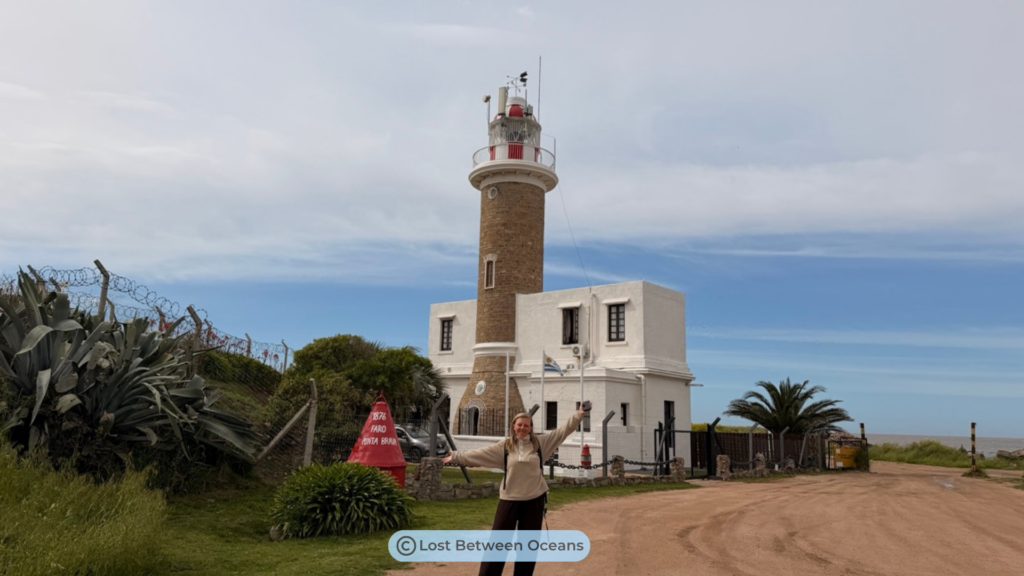
The Faro de Colonia del Sacramento, the lighthouse, rises from the ruins of the old Convento de San Francisco at the tip of the peninsula.
The climb is short, but you get to see the terracotta rooftops on one side and the brown-blue river on the other.
Entrance fee is 25 UYU ($0.65), and the hours are 10:00 to 12:30 and 14:30 to 18:30, with 111 spiral steps.
Watch sunset from the western tip

Colonia faces west across the water, which means its amazing sunsets are the town’s best free show.
The rocks and benches at the tip of the old town and the stretch of the Rambla nearby fill up with locals, mate thermoses and couples.
We got to watch 3 amazing sunsets from where we parked our car at a campsite facing west, amazing!
Our full season-by-season list is in our Uruguay packing list.
Colonia del Sacramento Tours: Worth It?
You’ll see plenty of Colonia del Sacramento tours for sale, mostly day trips from Buenos Aires that bundle the ferry, a guided walk, and lunch.
We haven’t taken the Buenos Aires day-trip bundles, so we can’t vouch for them.
The one we can recommend is Silex, because it is the one we did: a full day with Andres as your guide, and a winery lunch, in a region where the wineries are hard to reach without a car (and where nobody has to be the designated driver).
Book the Silex day we did here!
Our Day Trip with Silex Tours
On our day trip with Silex Tours, which included lunch at Fripp winery, he told us why Colonia was a smuggling town, why neighbouring houses are a hundred years apart, why the Río de la Plata is called the river of silver, how small immigrant colonies grew into towns, and why mate is called the saviour of the family.

We recommend Silex Tours if you want the history and the wine together.
They picked us up in a fancy car and toured us in Colonia town before heading to the winery.
| 🍷 Our Day with Silex Tours: The Itinerary | |
|---|---|
| Stop 1 | 🏛️ City centre and the old town, with Andres telling the history behind the streets. |
| Stop 2 | ☕ Coffee break to slow down before the rest of the day. |
| Stop 3 | ⚓ The port and the river views across the Río de la Plata. |
| Stop 4 | 🗼 The Colonia lighthouse for the best view over the rooftops. |
| Stop 5 | 🏟️ The Real de San Carlos bullring, restored and now a cultural venue. |
| Stop 6 | 🍇 Fripp winery: a tour of the vineyards with the owner, then a three-course lunch with wine. |
What it costs: ARS 357,977.88 per person (about €210, about $226), with private transportation, the Fripp winery visit, and a three-course lunch included.

🍷 Join Silex Tours in Colonia
Book this day if you want the history of Colonia and a winery lunch without worrying about driving. ARS 357,977.88 per person, with the Fripp winery visit and lunch included. Affiliate link, no extra cost to you.
Book Silex Tours in ColoniaWhat we’d skip in Colonia
- Every museum on the shared ticket: One museum already gives you the picture.
- Golf-cart rental to see the old town: the core town is small enough to walk, and the carts clog the narrowest lanes (and are super slow getting up on the hills).
- Expecting a big-city day: if you want nightlife, give that time to Montevideo instead.
And if you’re still weighing up whether the capital deserves more of your trip than Colonia, our honest take on whether Montevideo is worth visiting should help.
Best time to visit Colonia
- Spring (September to November): mild and green, our season, and good for walking and cycling.
- Summer (December to February): perfect for the river beaches and long evenings, but the busiest and priciest time.
- Autumn (March to May): soft light and harvest season at the nearby wineries.
- Winter (June to August): cool and quiet; museums and cosy restaurants work, beaches don’t.
For the month-by-month version, see our best time to visit Uruguay guide.

Getting to Colonia: Ferry and bus basics
⛴️ Ferry and bus basics
Colonia del Sacramento FAQ
What are the best things to do in Colonia del Sacramento?
Walk the Barrio Histórico early, photograph Calle de los Suspiros before the crowds, climb the lighthouse in the late afternoon, take a winery tour, then watch sunset from the western tip and walk the old town after dark.
What is the best time of day to visit Colonia?
Early morning and after dark. Day-trippers arrive mid-morning and leave in the late afternoon, and weekends are busiest because of weekenders from Buenos Aires.
How do you get to Colonia from Buenos Aires?
By ferry with Buquebus or Colonia Express, about 1 hour 15 minutes each way. Bring your passport and arrive about 90 minutes early.
Is the Colonia lighthouse worth climbing?
Yes. It’s a short, steep climb with the best view in town, for a small fee (about 25 UYU; verify on site). Check the closing time before you plan around it.
Is a wine tour in Colonia worth it?
We think so, mostly for the stories. Our guide Andres from Silex Tours explained the immigration history behind Uruguayan wine between tastings, which you won’t get from a bottle shop.

Final thoughts on things to do in Colonia Uruguay
For us, there are a handful of things that really qualify as the best things to do in Colonia:
- An early walk through the Barrio Histórico and Calle de los Suspiros
- The lighthouse in the late afternoon
- A day with Andres from Silex Tours, ending with lunch at Fripp winery
- Tannat cheese at La Vigna
🍷 If you only book one thing
Make it the Silex day: the old town with Andres’s stories, a winery tour with the owner and a three-course lunch at Fripp, with nobody driving. Affiliate link, no extra cost to you.
Check Silex Tours availability🛏️ Sleep in the old town
Stay inside the old town to see the lanes after the ferries leave. Our research picks: Charco Hotel for waterfront views, Posada Boutique Las Terrazas for a mid-range old-town stay, and Viajero Posada B&B on a budget. The one place we slept in is a cottage at La Vigna, if you’d rather be in the countryside.
Compare Colonia hotels on Booking.comWritten by Laura and Alexander, a travel couple overlanding through Uruguay, from Montevideo’s Ciudad Vieja to the wineries of Carmelo. We shipped our car from Colonia to Buenos Aires in Argentina.


*If you purchase something through our links, we may earn a small fee. However, you still pay the same (or even get a discount). Win-win! And one day we may get to be full-time travel bloggers!
Please check our affiliate disclosure policy for more details. Your suppport is appreciated!
We share travel guides for couples who want a little luxury, a lot of heart and lifelong stories to tell!
Laura and Alexander
Founders of Lost Between Oceans

Reviews
Lost Between Oceans gave me and my husband the perfect tips and destinations to plan our dream honeymoon in French Polynesia, making the experience stress-free.

I never thought I’d dare to go diving in a cenote and surfing in Mexico. Their travel guides made me more confident and adventurous, overcoming my travel fear of the unknown. Thank you!
I looked up Lost Between Oceans for last-minute tips about my roadtrip in the Amalfi Coast. They showed me the best cliffside villages and hidden beaches. This saved me a lot of time researching everything myself!



Related Posts